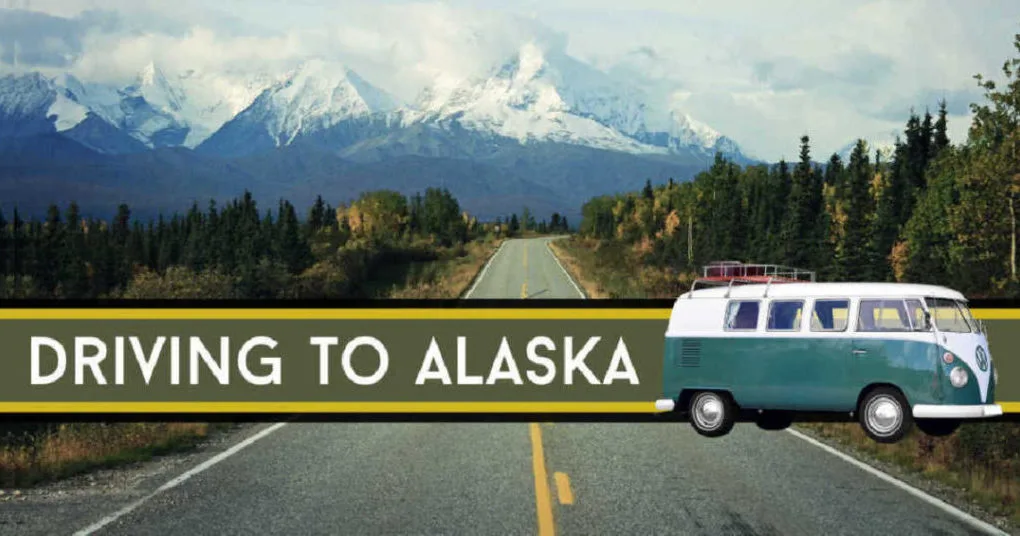
Driving to Alaska is officially the ultimate road trip, the kind of journey that makes other vacations look like quick weekend jaunts. If you’re the type who gets excited about epic scenery and doesn’t mind racking up some serious mileage, buckle up.
Along the way, plan on seeing some of the most spectacular scenery on earth. This once uncomfortable dirt road has transformed into a modern-day highway system, and it’s genuinely one smooth ride (thanks, infrastructure improvements!).
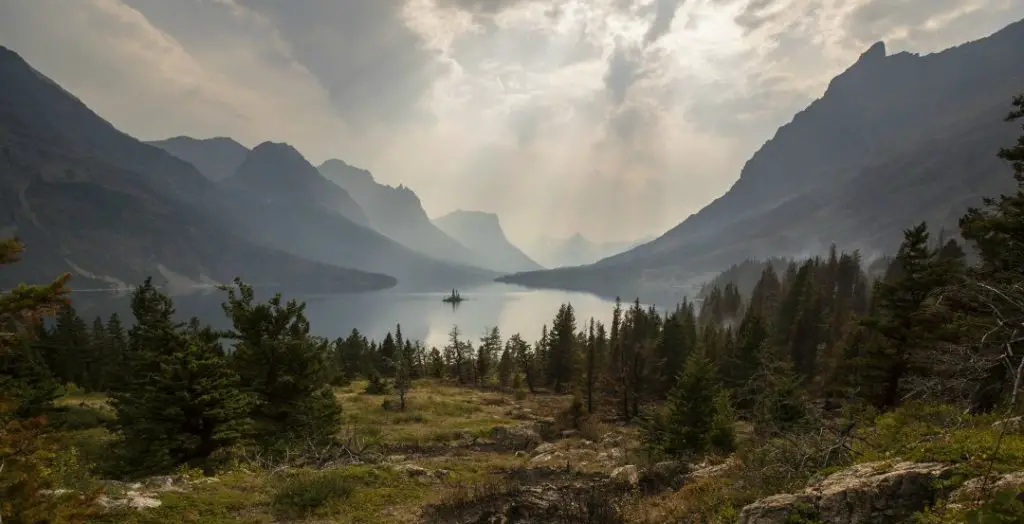
Here’s the truth: there are plenty of gas stations, accommodations, food stops, and visitor amenities all along the 1,500-mile journey. The only real curveball might be some light construction that causes minor delays, nothing worth losing sleep over.
Dawson Creek Marks the Start of the ALCAN
Dawson Creek, British Columbia, is where the Alaska Highway (also called the ALCAN Highway or Alaska-Canada Highway) officially begins. To reach “Mile Zero,” from the West Coast, you’ll drive north on Highway 97. Coming from the Midwest? Highway through Edmonton is the quickest route if you’re in a hurry.
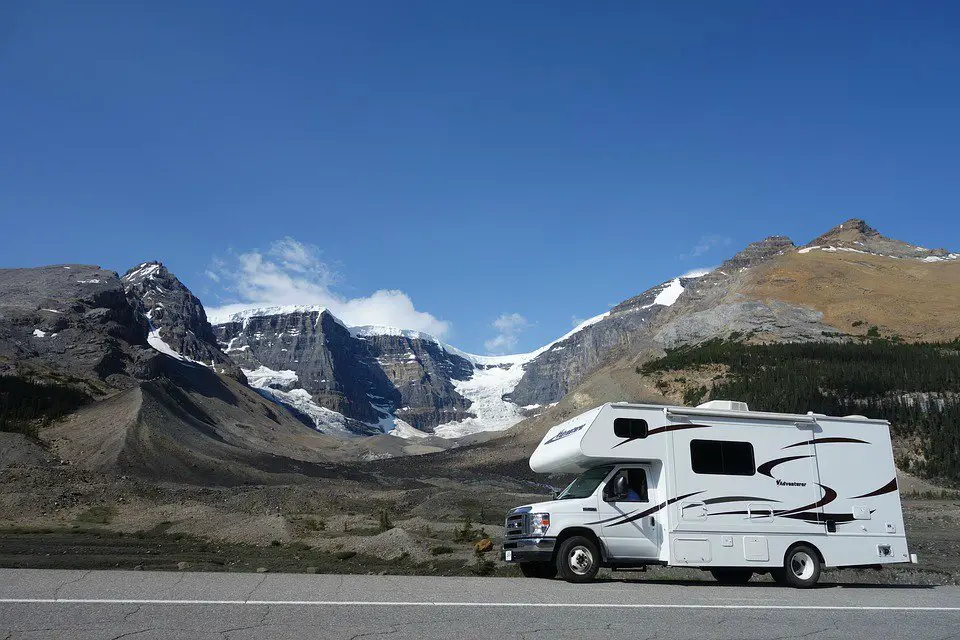
If time isn’t your enemy, though, detour through Calgary to visit Banff and Jasper National Park. They’re part of the Canadian Rockies, and they absolutely deliver. The route between Banff and Jasper is the legendary Icefields Parkway, widely considered one of the most impressive drives in the world.
Take a Jasper National Park Tour Check Availability
🚗 Driving Tip: Keep your eyes on the road and take it slow through here. We once had a massive bear vault over the guardrail and sprint across the highway like it owned the place, which, technically, it does.
Need a rental car? Check out Discover Cars, we’ve saved serious cash using them on previous trips.
The route concludes in Delta Junction, Alaska. But here’s the thing: arriving is just the beginning. The adventure’s far from over. Take your time, soak it all in, and don’t rush through this one.
There’s genuinely no other journey quite like it. Having your own wheels means you can explore at your own pace, which is exactly the way to do this.
With Limited or No Access to the Internet, You’ll Need This Guidebook
Adjusting to Life Without Stuff
For many travelers, one of the biggest adjustments is realizing that convenience stores and gas stations don’t run 24/7 out here. On an Alaskan road trip, you need to plan your day a bit more strategically than you might be used to.
Gas stations keep regular hours. Internet? Spotty at best. Cell coverage? It’s hit or miss (though better than it used to be). For most people, it takes a few days to shift into this slower rhythm. And if your GPS conks out due to lack of signal, you’ll be reaching for a physical map, which honestly isn’t the worst thing. We’re fans of the latest Rand McNally Road Atlas.
Budget Tip: Before you go, grab travel health insurance for your time in Canada. Healthcare is expensive north of the border, one of the priciest in the world. Travel insurance typically costs less than $10 per day and could save you thousands. We use Insubuy and their Patriot International Lite plan. It’s affordable, solid, and gives us the peace of mind we need.
Affordable Travel Health Insurance For Canada ➡️ Get a Free Quote
16 Things to Know Before Driving to Alaska
The trip isn’t as remote or dangerous as you might imagine, but smart precautions definitely matter. Here’s what you should know before heading north:
- During summer, expect gas stations, food options, and places to sleep roughly every 20 to 50 miles.
- Bring a credit card, as many stations are automated and won’t have an attendant on duty.
- Fill up your tank between noon and 5 p.m. to guarantee access to fuel. Want to save on gas? Keep those tires properly inflated. We grabbed this compact digital tire compressor, which auto-shuts off and fills a 17-inch tire in two minutes!
- Canada runs on the metric system, so road signs will look different. Speed limits are in kilometers per hour (KPH), where 1 mile = 1.61 kilometers. Gas is sold by the liter, where 1 gallon = 3.79 liters.
- Budget an extra 20% for gasoline compared to U.S. prices along the route.
- Most of the highway is a two-lane paved asphalt road with gravel shoulders wide enough for standard vehicles.
- Check weather forecasts regularly to avoid driving during sketchy conditions.
- Drive with your headlights on.
- Radar detectors are illegal in Canada.
- If slow travel is your style, plan for at least four weeks total (round-trip) to do it justice.
- Whitehorse is the Yukon’s territorial capital and the largest town along the route.
- Speed more than 40 kph (25 mph) over the limit in British Columbia, and your vehicle could be impounded.
- If you’re crossing the border with any kind of weapon (including bear spray), verify the rules with the Royal Canadian Mounted Police first.
- Talk to your cell provider about coverage along the route; you might be surprised it’s included at no extra charge. If coverage is spotty, consider a satellite phone as backup. Keep everything charged in case of emergencies. We grabbed this 3.0 Port 36W/6A fast car charger, and it charges our phones 3x faster, game changer.
- The ideal window for this drive is May through September.
- Accommodation options are limited and book up quickly, especially in summer. Reserve as early as possible. Check the best lodging options below.
7 Best Stops Along the Way
You’ll be passing through some of the world’s most pristine wilderness. This route is beloved by independent travelers chasing outstanding scenery, unique cultural attractions, adventurous tours, and truly unforgettable experiences.
Whitehorse and Haines Junction both deserve a couple of days of your time; there’s genuinely a lot to explore. Beyond those two, here are seven highlights you absolutely shouldn’t miss, heading south to north:
- Sikanni Chief Falls Protected Areas: A stunning 100-foot waterfall that’s basically nature showing off. Bonus points if you nail the pronunciation on the first try.
- Stone Mountain Provincial Park: Come for the epic hiking trails, stay for the moose sightings. It’s like a wildlife reality show, minus the drama.
- Muncho Lake Provincial Park: Pure serenity with jaw-dropping jade-colored waters and nary a Wi-Fi signal in sight. Your phone will survive the digital detox. Probably.
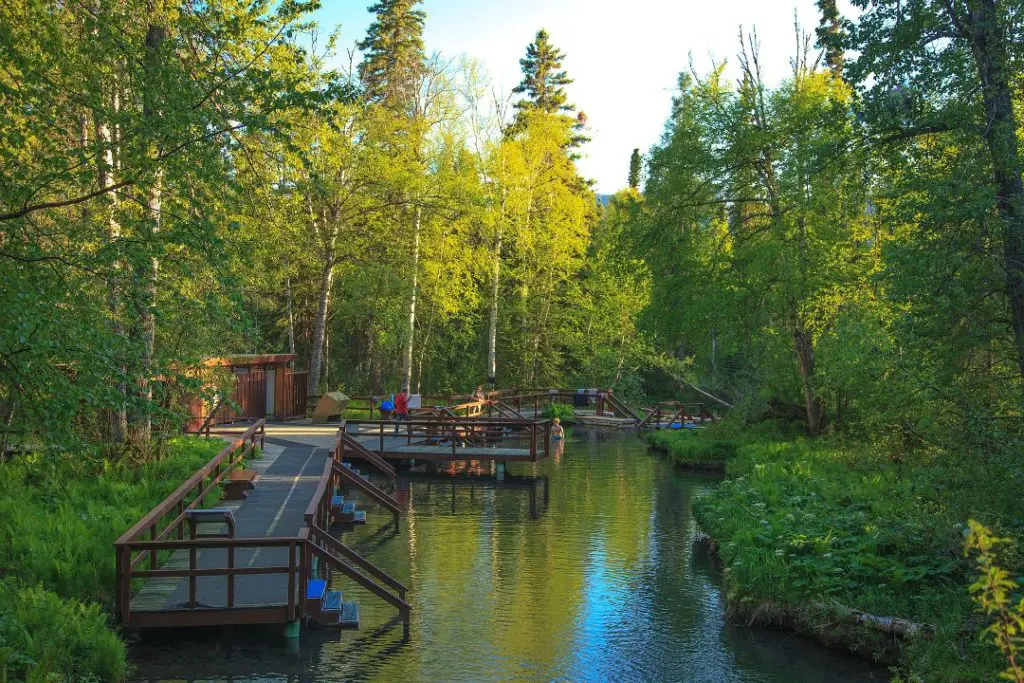
- Liard River Hot Springs Provincial Park: It’s like a spa day, but outdoors and possibly with moose. Soak it in, literally.
- Sign Post Forest near Watson Lake: Thousands of signs from around the world in one delightfully quirky pit stop. Bring your own sign if you want to leave your mark.
- Tetlin National Wildlife Refuge: Gorgeous vistas, wild creatures doing their thing, and a front-row seat to nature’s greatest show. Bring binoculars for the full experience.
- Muklukland: Quirky, wonderfully weird, and packed with roadside character. Part museum, part carnival, entirely awesome.
Best Places to Stay Along the Way
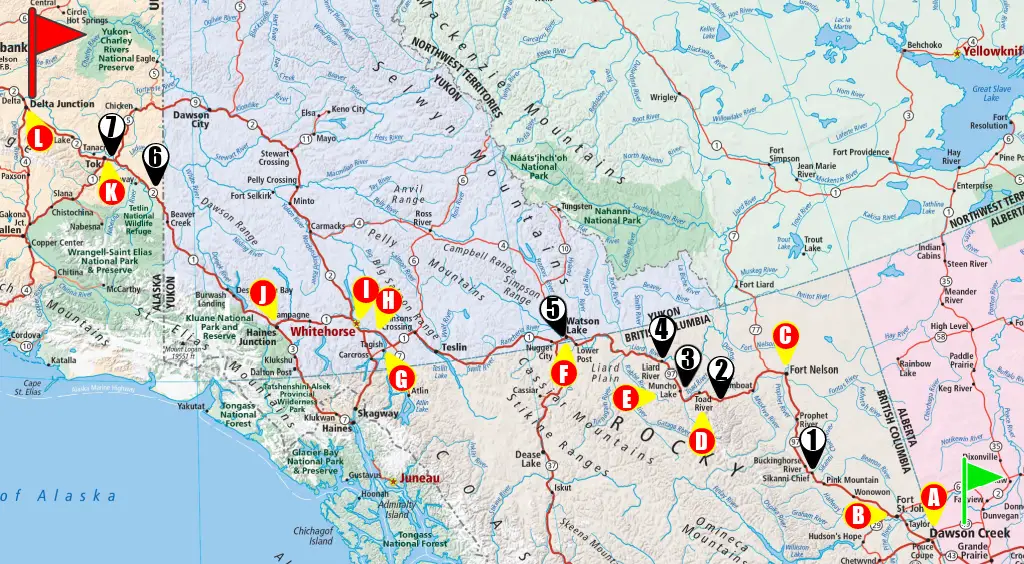
Below are the best places to rest your head (matched with the map above), heading south to north from Dawson Creek to Delta Junction. Book early; these fill up fast, and your options are genuinely limited.
(A) Dawson Creek: Best Western Dawson Creek (laundry, sauna, fitness center)
(B) Fort St. John: Ramada by Wyndham Northern Grand Hotel & Conference Centre (clean and modern)
(C) Fort Nelson: Woodlands Inn & Suites (laundry facilities)
(D) Toad River: Stone Mountain Safaris Bed and Breakfast (hot tub)
(E) Muncho Lake: Double G Service (serves American cuisine)
(F) Watson Lake: A Nicer Motel (charming motel with kitchenettes)
(G) Tagish: Little Atlin Lodge (boat rentals and fishing on site)
(H) Marsh Lake: Inn On The Lake (fitness center, hot tub, and sauna)
(I) Whitehorse: → Hidden Valley Bed and Breakfast ←
(J) Haines Junction: Parkside Inn (breakfast includes eggs, muffins, and fruit)
(K) Tok: A Hyde Away Inn B&B (balconies with mountain views)
(L) Delta Junction: Alaska Frontier Inn (kitchenette)
Our Favorite Inn Is a Must-Stay Along the Way? See It Here!
Top 4 Popular Tours in the Yukon
- Get a taste of the Yukon Wildlife Preserve on this half-day tour, where you can see and photograph wildlife in its natural habitat. Your guide will also take you to nearby hot springs for the full experience.
- Take a half-day snowshoeing adventure through Canada’s Yukon wilderness. Strap on lightweight snowshoes and explore deep snowy terrain while spotting native coyotes and hares. Your guide will share centuries of gold-mining and fur-trading history as you traverse the landscape. Includes hotel pickup/drop-off, snowshoes, warm beverages, and snacks.
- Late summer brings this incredibly sought-after Northern experience. You’ll be picked up in Whitehorse and taken to a custom viewing spot to witness the stunning colors of the aurora borealis.
- There’s something for every type of traveler! From scenic flights to wildlife encounters and guided hikes, the Top 10 Tours offer options for any kind of explorer.
Highway 37 Stewart-Cassiar Scenic Route
On your return south, consider ditching the ALCAN and trying Highway 37, the Stewart-Cassiar Scenic Route. Whether you take Highway 37 or 97 from Watson Lake toward Prince George, the drive time is roughly identical, so why not mix it up?
Highway 37 might not be quite as famous as Highway 97, but it has real perks: less traffic, smoother pavement, better wildlife spotting opportunities, and its own collection of lakes and provincial parks worth exploring.
Just know this: from Watson Lake to Kitwanga, cell service is spotty. Book your accommodations in advance. There’s really only one inn along the way, Northway Motor Inn in Dease Lake. If you skip it, you’re looking at another 6+ hours to reach Highway 16 in Kitwanga. Once on Highway 16, the LDR Lodge – Last Dollar Ranch is an excellent option.
What to Do to Prepare Your Vehicle For Driving to Alaska
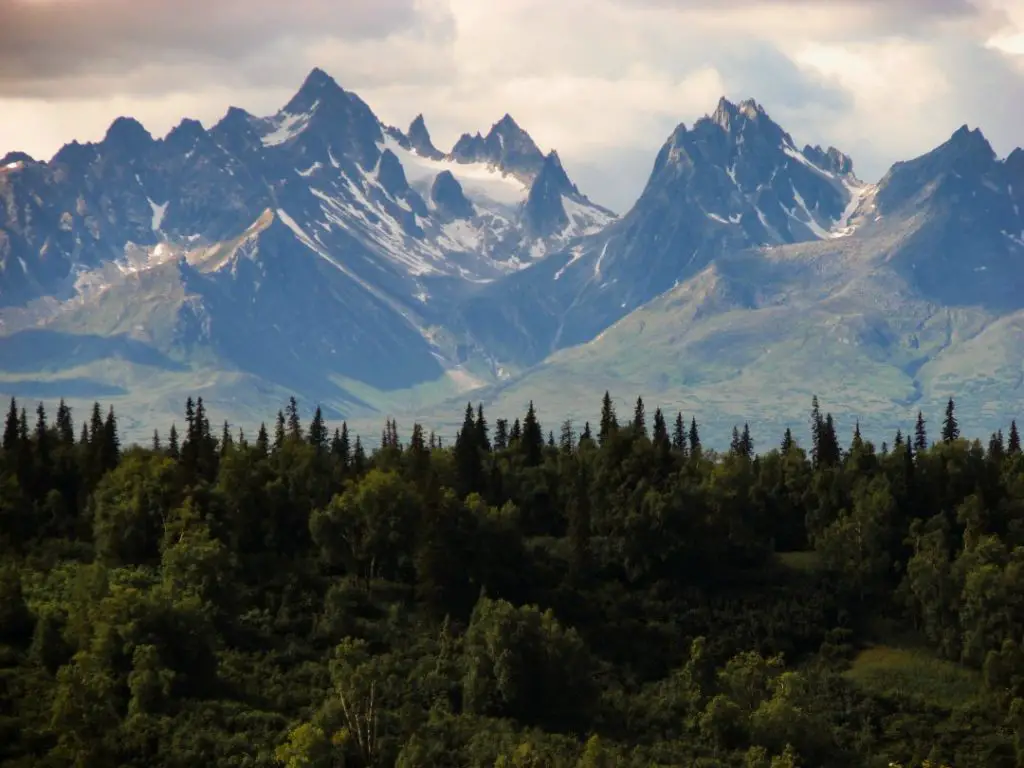
Nearly any vehicle can make this trip, even a motorcycle! At roughly 48 hours nonstop, you need a vehicle you genuinely trust and feel safe in. We’d recommend taking at least a week so you can actually enjoy the stops along the way.
Before you leave, do basic maintenance: schedule service checkups, top off all fluids, and make sure you can actually change a flat tire (and have the right equipment to do it).
Here’s a packing list of emergency and maintenance items worth having:
- Roll of duct tape (for blown hoses and other quick fixes)
- A couple of microfiber towels and reusable rags
- Spare key: stash it in your purse or wallet
- Flashlight: an everyday strong flashlight or this high-powered version for spotting wildlife at night (both USB charging)
- Extra drive belt
- Bottled water in a 12-Volt refrigerator and snacks for emergencies
- Reliable jumper cables
- Tire gauge and compressor
- Funnel for adding fluids
- Bucket: great for storing items and general utility
Is Driving to Alaska Worth It?
Absolutely, especially if you’re the road trip type. It’s an epic journey through genuinely scenic roads, hitting fun and interesting spots that most people never experience. That said, it eats time, consumes gas, and some stretches are mundane. Like most worthwhile adventures, you take the good with the bad.
The journey from the U.S.-Canada border near Montana covers roughly 2,000 miles (one-way) to reach Alaska. Driving nonstop, you’re looking at about 32 hours.
Here are distances and times from other starting points:
- Denver, Colorado to Alaska: 2,800 miles, 47 hours
- Dallas, Texas to Alaska: 3,500 miles, 58 hours
What’s the Best Guidebook For Driving to Alaska
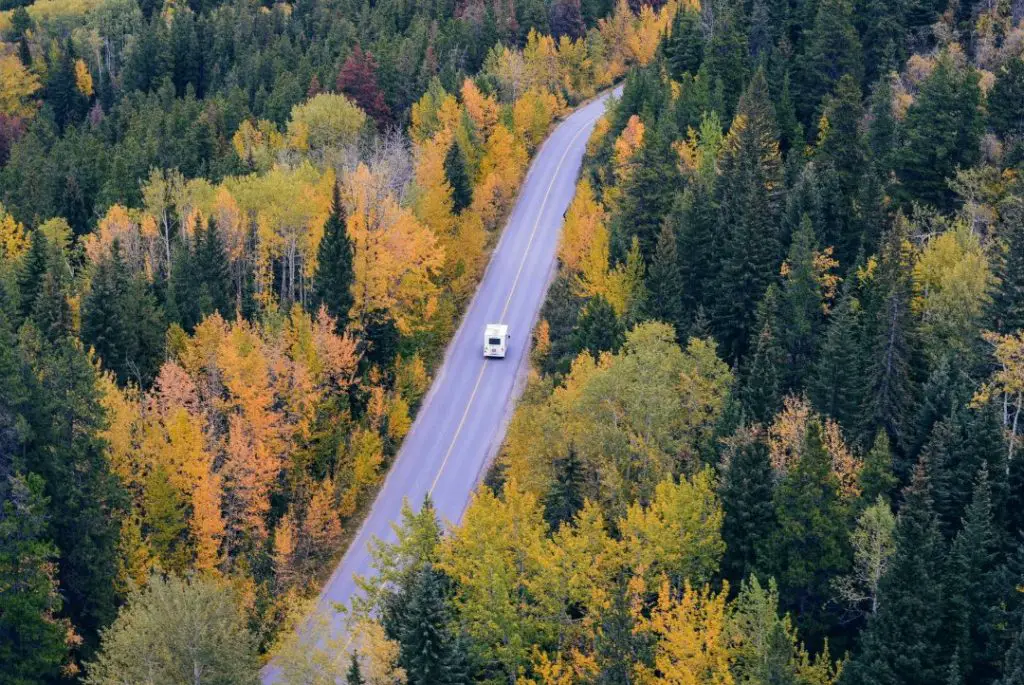
Thoughtful planning unlocks the chance to experience a landscape largely untouched by development, where wild animals roam freely across terrain covered with glaciers, tundra, mountains, lakes, streams, and forests. The trade-off? Limited roads and sparse tourist infrastructure.
The Milepost 2025 travel planner is a 700+ page guide with mile-by-mile breakdowns of 15,000+ miles of road in Alberta, British Columbia, the Northwest Territories, Yukon, and Alaska.
It’ll help you track down accommodations, gas stations, restaurants, sightseeing spots, stores, and attractions. These facilities can be sparse and separated by unpredictable weather, so having detailed intel matters.
📕 Milepost 2025 Travel Planner ➡️ Buy Now
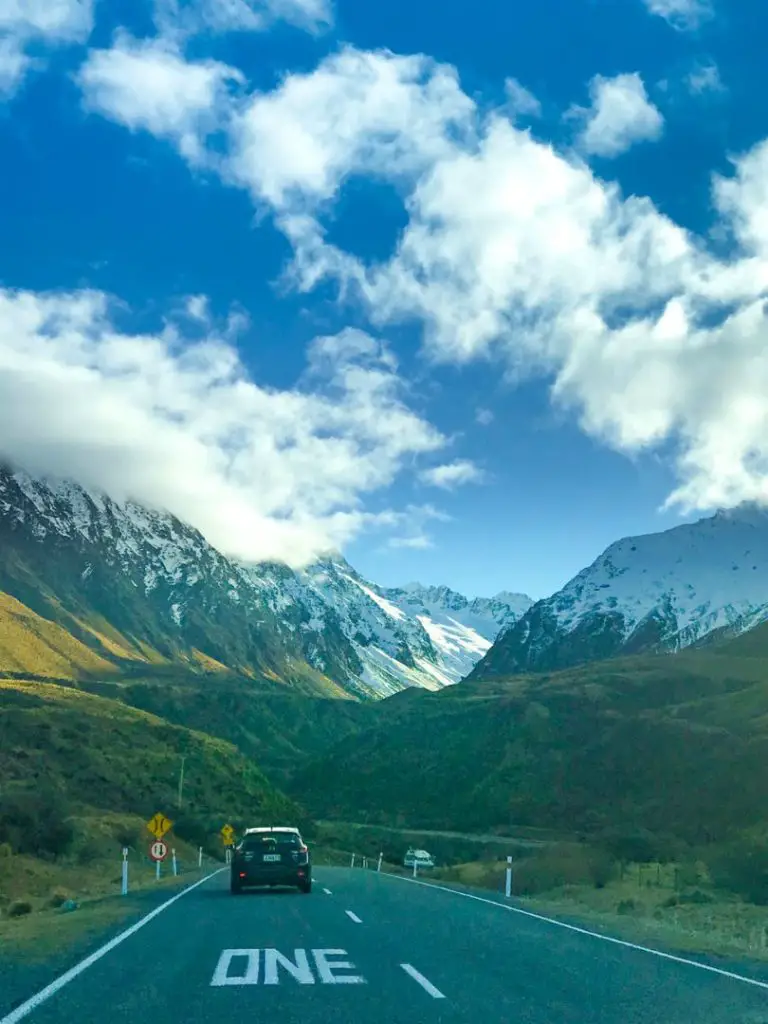
Everything fills up quickly come summer. Smart planning ensures your experience meets, or beats, your comfort expectations. The Milepost is an essential travel planning resource most visitors need. You know it’s the real deal when locals carry copies with them.
We Need Your Help
Did you find this article helpful? Bookmark it and use the links below when planning your next trip. You’ll get the best prices, we may earn a small commission, and it helps keep this site running.