

You find a killer round-trip to Barcelona for $1,240. Boom. Perfect. Into the cart it goes. Two hours later? $1,560. Next morning? $1,890.
This isn’t demand playing out naturally. This is AI and cookies teaming up in real time, watching your every move, and literally repricing while you’re still staring at the screen.
If you’ve ever wondered why travel prices go up after you search, this is exactly what’s happening, and it’s way faster than it was just two years ago. We dug into 12 trips and 40+ flights to show you exactly how the machine sees you, and more importantly, how to outsmart it.
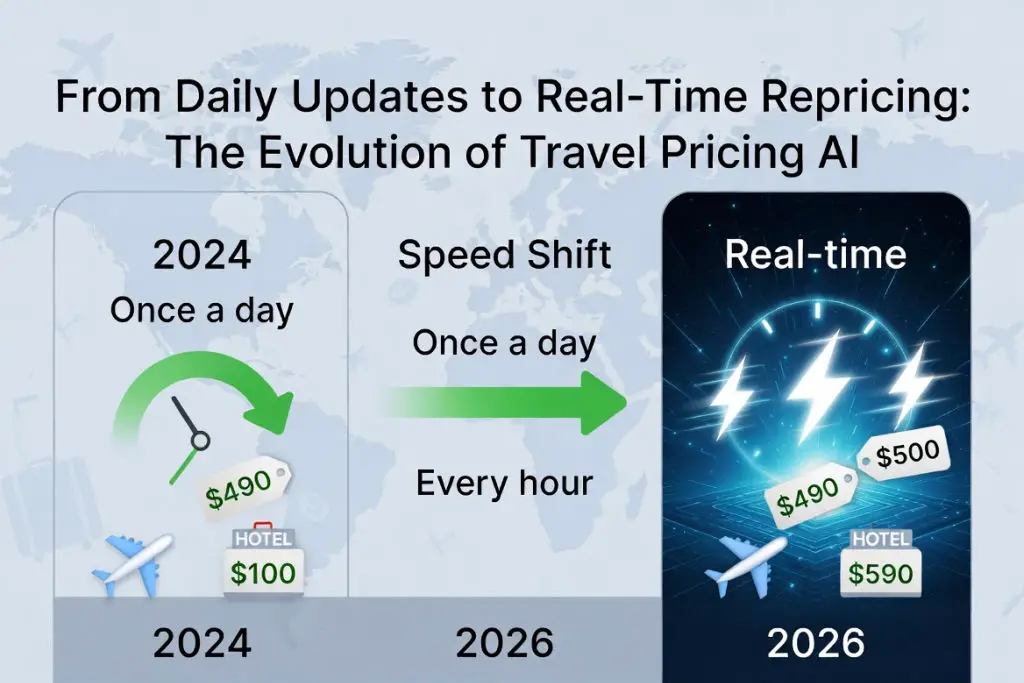
Why Travel Prices Go Up: The Speed Shift
2024 vs. 2026: When the Algorithm Woke Up
Back in 2024, dynamic pricing was basically a lazy teenager. Airlines and hotels would tweak rates once or twice a day, based on big, clumsy demand data. You could blink and still have time to compare prices. Wild times.
Now? The AI doesn’t sleep.
It’s not one master AI controlling everything; it’s everywhere. Airlines lead the pack on aggressive AI core pricing, with Delta especially, ramping up AI-determined fares fast.
Meanwhile, travel comparison sites like Booking.com, Expedia, Skyscanner, Kayak, and Google Flights run their own systems too, but they’re mostly layering recommendations and tweaks on top of what the airlines feed them.
The moment you search for a flight, invisible trackers log it like a digital breadcrumb trail straight to your wallet. Cookies build a profile. The system figures out how badly you really want this deal. Then it runs a little test: what if we raise it by $200? Will they still bite?
We’ve tracked price jumps of 20–50% within hours of repeat views. A Barcelona flight we tested? $1,240 one minute, $1,890 the next morning. Same flight, same seats, same destination. Just a very different algorithm decision about what you’ll tolerate. This is exactly why travel prices go up after you search; the system is actively testing your limits.
This happens at the best Vegas hotels, Mexico getaways, African safaris, everywhere. The speed is just insane now.
⚠️ The Shift That Matters: Two years ago, you had days to think. Now? Decent prices last hours, maybe less. If you see a fare that doesn’t make you wince, book it immediately. Your window is literally closing while you read this.
Google Flights, Hotels.com, and car-rental sites are all playing the same game. It’s not a conspiracy, it’s just capitalism with better math.
Walmart’s Digital Labels: The Honest Mirror
Same Tech. Totally Different Game.
While you’re getting quietly price-gouged online, Walmart is rolling out digital shelf labels—tiny electronic screens—in every U.S. store by the end of 2026 (already live in some locations as of early 2026). These screens update prices across 120,000+ items in minutes instead of days.
Here’s what’s genuinely wild: Walmart made pricing instant and digital. But they kept it the same price for everyone in the store. No cookies. No, “you touched that granola bar twice, so now it’s $2 more.” Just straightforward, boring, honest pricing.
☑️ Why Walmart Went Fair: Retail transparency is a brand thing. Customers see prices changing on shelf tags. It feels (and is) unfair if person A pays $5 and person B (five feet away) pays $8 for the same granola bar. Bad for PR. Worse for trust.
✅ Travel Sites? Different Story: Pricing happens in pixels. Nobody compares notes in real time. The opacity is built in. Travel companies took the speed and added the surveillance layer.
The Real Question: Could Walmart flip the switch tomorrow and go personal? Legally? Yes. They could. But they probably won’t, unless retail competition gets truly insane. Travel already did.
How the Algorithm Actually Sees You
The Data Behind Why Travel Prices Go Up After You Search
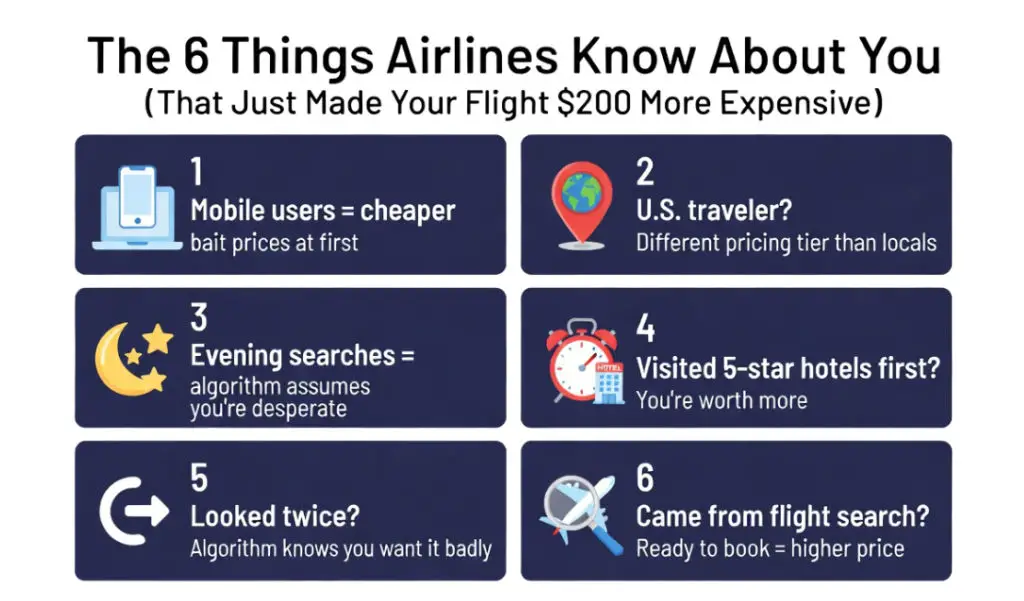
To make this real, here’s exactly what the system is watching:
- Device type: Mobile users see lower initial prices, then higher prices on repeat searches.
- IP geolocation: U.S. traveler booking Europe? Different pricing tier than a local.
- Time of day: Evening searches = higher rates (algorithm assumes you’re desperate).
- Browser history: Visited luxury hotels first? You’re worth more.
- Return visits within hours: Repeat looker = willing to pay a premium.
- Referer source: Came from a flight search? You’re ready to buy soon.
Combine all six, and the AI builds a “willingness-to-pay” score for you personally. Then it tests prices to find your breaking point. Hotels and online travel agencies are openly celebrating 10–15% revenue bumps from this strategy.
Congress is starting to ask questions about “surveillance pricing.” But the game moves faster than lawmakers.
Where You’ll Feel It Most
The Usual Suspects (All of Them)
Booking.com: Fastest re-pricer in the game. Repeat searches = higher rates almost immediately.
Expedia & Hotels.com: Device and location differences are real; fresh IP = lower initial price, repeat visits = price climb.
Priceline: Aggressive dynamic pricing with flash deals. Low starting prices, quick re-pricing on revisits.
Skyscanner: Tracks price changes across airlines in real time. Good for setting alerts and spotting the repricing moment.
Airlines (via CheapTickets or direct bookings): Fare buckets empty and refill higher within hours.
Cruises (Cruise Direct, Holland America): Same repricing game, especially during peak seasons and holidays.
How to Outsmart It (Without Losing Your Mind)
6 Budget-Savvy Hacks That Work
- Search in incognito mode first. This wipes the slate clean, so cookies don’t immediately start building your profile; it’s your best shot at seeing the “civilian” baseline price before the algorithm tags you as interested.
- Think a VPN or incognito will completely hide you? Think again. The AI still sees the interest you’re creating behind that VPN (or incognito), all those searches for the exact same route and dates. It doesn’t always need your real location to adjust prices. When you finally log in or go to book, you can end up bidding against yourself. VPNs can help test regional pricing differences, but they’re not foolproof against behavior-based tracking.
- Clear cookies or switch devices/browsers. Look like a fresh traveler. Many still report $100–$300 savings on longer bookings just from resetting the profile.
- Book decent rates immediately. Waiting a few hours is now volunteering to pay 15–30% more. The window is closing.
- Compare 3–4 sites at once. Prices differ wildly; the algorithm assumes you won’t compare everything. Try Kayak, Skyscanner, and Priceline side-by-side.
- Set price alerts on Skyscanner or Kayak. Track when the market actually moves, not when the booking site wants you to panic-buy.
- Check the property or airline directly. Many offer better deals to skip OTA fees entirely. For vacation packages, Apple Vacations and Funjet Vacations often have direct deals that bypass OTA repricing.
- Get travel insurance before prices spike further. If a 40% price jump forces you to cancel, you need real protection. Insubuy compares 20+ plans side-by-side for flights, hotels, and general travel, often cheaper than you’d expect. For cruises specifically, Seven Corners covers missed ports, itinerary changes, and diversions that cruise lines won’t refund.

Bottom Line: Why This Happens (And How to Stop It)
Walmart proved the future is instant. Travel proved the future is also personal. And weirdly invasive.
Now you know why travel prices go up after you search. That $1,240 Barcelona flight? It was never actually $1,240 for you. That was the bait price, the one designed to make you click. The moment you did, the machine woke up. It calculated your desperation score. Then it started raising the price to find your breaking point.
Next time you see a decent fare?
Overthink it and lose money. Skip the seventeen-tab comparison game. Stop waiting for a “better deal.” The AI already knows you’re interested, and it’s actively making that deal worse as you read this.
Book it. Your wallet will thank you, and so will your future self sipping that cheaper paella.
🛡️ One More Thing: Price Hikes Happen. Get Protected.
Now that you know why travel prices go up after you search, here’s the real talk: trip cancellations and price disasters happen. If prices spike 40% and you need to bail, you’re eating that loss unless you have the right insurance.
For flights, hotels & general travel: Insubuy compares 20+ plans side-by-side. Real coverage at budget prices, often $20–$50 for 2-week trips. You can adjust deductibles to fit your wallet.
For cruises specifically: Seven Corners covers missed ports, itinerary changes, and diversions, the stuff cruise lines won’t refund. Perfect backup when prices or schedules go sideways.
We Need Your Help
Did you find this article helpful? Bookmark it and use the links below when planning your next trip. You’ll get the best prices, we may earn a small commission, and it helps keep this site running.